
The Oregon Bicycle Bill: Southern Oregon's Forgotten Legacy
The Oregon Bicycle Bill: Southern Oregon's Forgotten Legacy
In 1971, Oregon became the first state in the nation to require that public roads include bicycle and pedestrian infrastructure. The law that made it happen, House Bill 1700, didn't come from Portland. It came from a Republican state representative from Jacksonville named Don Stathos, who got the idea after he and his daughter were run off the road while riding a tandem bicycle to Medford.
Southern Oregon is the birthplace of the Oregon Bicycle Bill. And right now, Medford is undoing exactly what it made possible.
What the Bicycle Bill Requires
Codified as ORS 366.514, the law is straightforward:
- Bicycle and pedestrian facilities must be included wherever a road, street, or highway is built or rebuilt
- A minimum of 1% of the State Highway Fund must be spent on footpaths and bicycle trails by ODOT, cities, and counties each fiscal year
- The law created the Oregon Bicycle and Pedestrian Advisory Committee, which awards grants for bike and pedestrian infrastructure
This wasn't a suggestion. It was the law in 1971, it was upheld by the Oregon Court of Appeals in 1995, and it's still the law today.
Governor McCall Signed It on a Bicycle
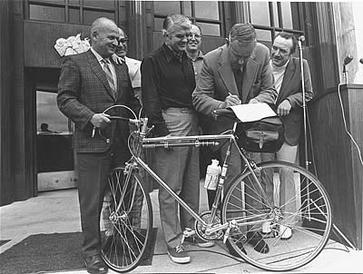
On June 11, 1971, Governor Tom McCall signed the bill into law on the steps of the Oregon State Capitol, using the seat of a Schwinn Paramount as his desk. The bill passed the House 36-21 and the Senate 19-11, powered by grassroots support from cyclists across the state. Portland State professor Sam Oakland organized a mass ride of over 400 cyclists from Portland to Salem to convince lawmakers to pass the bill.
It was a moment Oregon should be proud of. The Bicycle Bill foreshadowed the national Complete Streets movement by decades. Other states followed Oregon's lead because Oregon went first.
Southern Oregon Started This
Don Stathos represented Jacksonville. He rode his bike to Medford. The dangerous conditions he experienced on southern Oregon roads are what motivated the bill in the first place.
55 years later, the city he was riding to is spending over a million dollars to rip out a bike lane on Main Street and replace it with sharrows, painted arrows that research shows perform worse than doing nothing at all.
The irony is hard to overstate. The place that inspired Oregon's most forward-thinking transportation law is now the place most aggressively moving backward.
The Bill Has Survived Repeal Attempts
The Bicycle Bill has been challenged repeatedly over the decades. As recently as 2025, Oregon Republicans proposed repealing it entirely. Every time, it has survived because the principle behind it is sound: roads are for everyone, and the state has an obligation to build them that way.
Meanwhile, efforts to strengthen the bill have continued. Senate Bill 395, introduced in 2021, proposed increasing the required spending from 1% to 5% of the State Highway Fund.
The bill endures because it works. Oregon has some of the best cycling infrastructure in the country because of it.
Medford Should Be Celebrating This Legacy
Instead of removing bike lanes, Medford should be pointing to the Bicycle Bill as a point of pride. A southern Oregon legislator changed the entire country's approach to transportation planning. That's the kind of legacy a city should build on, not tear down.
The council still has time to reverse course before the restriping begins. If Don Stathos were riding his bicycle to Medford today, it makes one wonder what he would think of Medford removing a key piece of bicycle infrastructure.
Correction (March 4, 2026): A Note on the 1% Requirement
The Bicycle Bill requires ODOT, cities, and counties to expend "reasonable amounts" to provide footpaths and bicycle trails. The 1% spending figure is the absolute floor, not the target. The real standard is whatever counts as "reasonable amounts" needed to build out adequate bike and pedestrian infrastructure.
Of course, "reasonable amounts" has never been formally defined. Everyone, including Bike Medford, will have their own interpretation of what that means. But the point stands: 1% is the bare minimum, not the goal.
Comments
No comments yet. Be the first!